Teaching _________ developing countries brings _________ it many ___________ and rewards.
Teaching is an activity which is ___________ directly or indirectly, by human beings ___________ human beings.
Read the sentences below. Which sentence expresses which view? 1- I'm giving up work tomorrow. 2- I imagine Jack will win the championship. 3- I'm going to retire when I'm about 55. 4- That must have been George. 5- Can I borrow your pen for a moment?
Rewrite the following sentences so that they have the same meaning. 1 - Perhaps he hasn't received our letter. 2 - I've never read such an interesting book. 3 - We've been lent some money by my wife's parents. 4 - "You stole the money", I said. 5 - The flight was so long that we had three meals on board.
We were sure we were going to ___________ the train, but ____________ we didn't, actually.
Give the function of the underlined words: The citizens elected Bush President.
Classify the verb in the following sentence: The news made me happy.
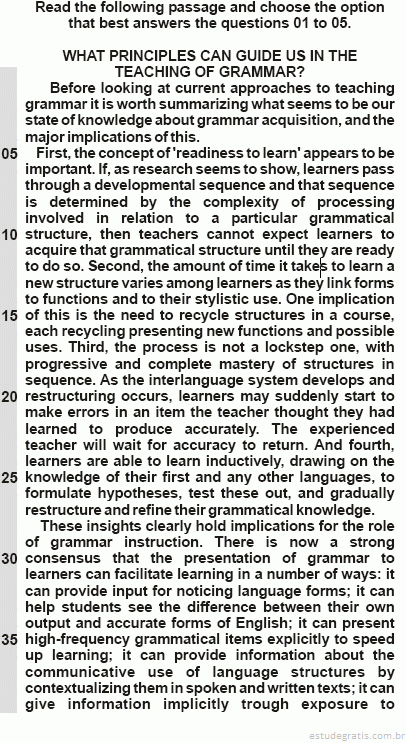
Read the following passage and choose the option that best answers the questions 01 to 05.


"The concept of 'readiness to learn'" (line 5) implies that:
Jeremy Harmer in his book The Practice of English Language Teaching says:
"Developmental errors: for a long time now researchers in child language development have been aware of the phenomenon of 'over-generalisation'. This is best described as a situation where a child who starts by saying Daddy went, They came, etc. perfectly correctly suddenly starts saying *Daddy goed and *They comed. (...) Foreign language students make the same kind of 'developmental' errors as well". (p. 100). We can infer that:
As far as motivation is concerned, Jeremy Harmer says that:
"At its most basic level, motivation is some kind of internal drive which pushes someone to do things in order to achieve something. As H Douglas Brown points out, a cognitive view of motivation includes factors such as the need for exploration, activity, stimulation, new knowledge, and ego enhancement (Brown 2000: 160-166). (...)
Marion Williams and Richard Burden suggest that motivation is a 'state of cognitive arousal' which provokes a 'decision to act' as a result of which there is 'sustained intellectual and/or physical effort' so that the person can achieve some 'previously set goal' (Williams and Burden 1997: 120). They go on to point out that the strengt...