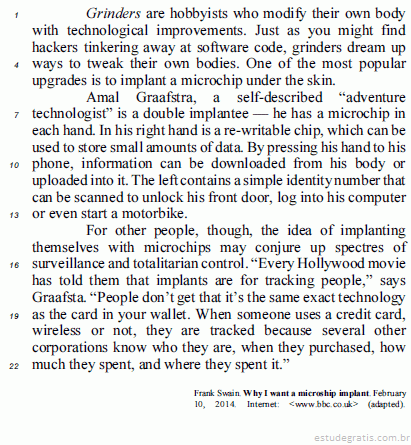
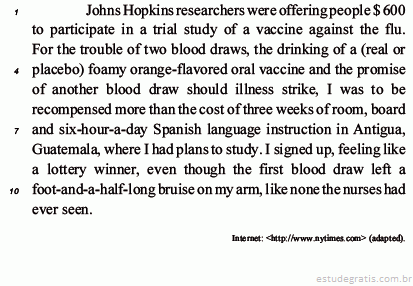
As far as the use or omission of the definite article is concerned, judge the following items referring to the text above.
On line 34, the definite article should be used right before “recognition”.

As far as the use or omission of the definite article is concerned, judge the following items referring to the text above.
On line 34, the definite article should be used right before “recognition”.

With respect to the use of prepositions and considering the previous text, judge the items below.
On line 11, the preposition that follows “succeeded” is at.

With respect to the use of prepositions and considering the previous text, judge the items below.
The preposition to be placed after “taught” (l.12) is on.

With respect to the use of prepositions and considering the previous text, judge the items below.
The preposition from should be used after “refuge” (l.27).

With respect to the use of prepositions and considering the previous text, judge the items below.
On line 36, the preposition by comes after “vital”.

With respect to the use of prepositions and considering the previous text, judge the items below.
On line 41, the preposition that comes after “eat” is in.

In the previous text,
the word “increasingly” (l.3) can be replaced by quite with no difference in meaning.
According to the established rules of phonetics and phonology of the English language, judge the items below.
The sound of the letter a in ago and in about is unstressed and it is called a schwa.
According to the established rules of phonetics and phonology of the English language, judge the items below.
The following sets of words are illustrative of minimal pairs: toe/so, later/litter, they/day, bid/bead.
According to the established rules of phonetics and phonology of the English language, judge the items below.
A shift (or change) in the stressed syllable of nouns such as contract, defect, object, progress turns them into verbs.