Judge the following items based on the text above.
The fragment “translational conundrums” (L.14-15) could be correctly and appropriately enigmas apresentados pelo texto original or as enigmas tradutórios.
Judge the following items based on the text above.
The fragment “translational conundrums” (L.14-15) could be correctly and appropriately enigmas apresentados pelo texto original or as enigmas tradutórios.

Considering the text and the topics to which it refers, judge the items below.
The word “assemble” (L.9) is synonymous with gather or put together.

Considering the text and the topics to which it refers, judge the items below.
Humans should always produce the initial draft translation instead of post-editing a raw machine translation.

Considering the SONY TV ad above, it is correct to state that
“cutting edge” (L.1) means different.
Considering linguistics aspects of English, judge the following items.
The following sentence presents a problem of “meaning”: “Emotion is running high at the moment, but that emotion must not be allowed to temper sensible judgement”.

Based on the text, judge the items from 111 to 120.
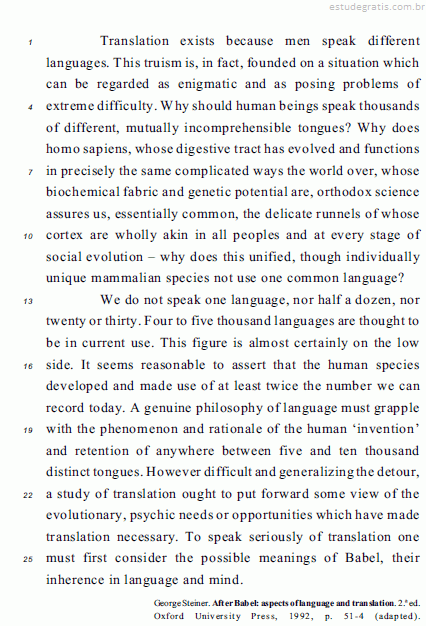
If the phrase “grapple with” (L.18-19) were to be replaced by deal with, come to grips with, or tackle, the general idea conveyed in the text would remain the same.

Based on the text, judge the items from 111 to 120.
For the author, the act of translation is connected with philosophical issues which have a straightforward and easy explanation: “men speak different languages” (L.1-2).

Based on the text, judge the items from 111 to 120.
In the first paragraph the author emphasizes the biological similarities presented by human beings and claims that people are the same but for the different languages they speak.

Based on the text, judge the items from 111 to 120.
The choice of language used in the second paragraph indicates the author’s certainty both about the existence of a large quantity of tongues spoken by humans and about the number of such languages.

Based on the text, judge the items from 111 to 120.
The use of “runnels” in “the delicate runnels” (R.9) is connotative, for the primary meaning of runnel is a small stream or brook.