981 Q1022685
Língua Inglesa
Ano: 2022
Banca: Quadrix

Text for the items from.


Judge the items from.


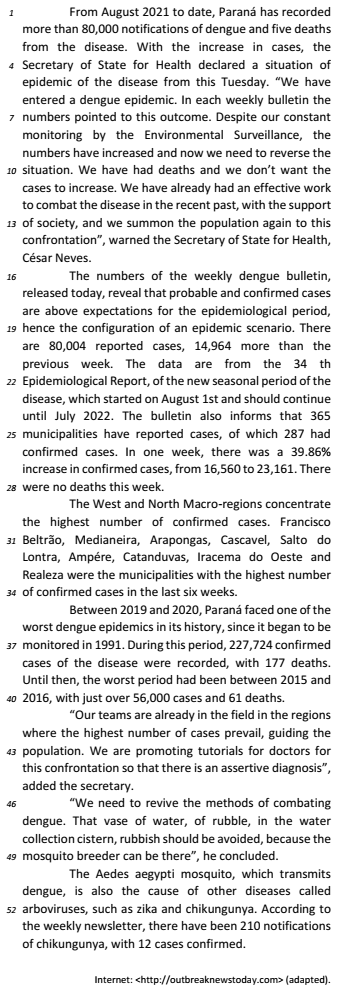
Arboviruses is the name of other diseases caused by Aedes aegypti mosquito. 
982 Q1022684
Língua Inglesa
Ano: 2022
Banca: Quadrix

Text for the items from.


Judge the items from.


Tuesday (line 5) is a day of the week and it is the day after Friday.

983 Q1022683
Língua Inglesa
Ano: 2022
Banca: Quadrix

Text for the items from.


Judge the items from.


Dengue epidemics started to be monitored in the early 90s. 
984 Q1022682
Língua Inglesa Interpretação de texto | Reading comprehension
Ano: 2022
Banca: Quadrix

Judge the items from.


There were 61 deaths registered this week. 

985 Q1022552
Língua Inglesa Interpretação de texto | Reading comprehension
Ano: 2022
Banca: FGV
The title of the text implies that the author will:
986 Q1022551
Língua Inglesa Interpretação de texto | Reading comprehension
Ano: 2022
Banca: FGV
Here’s why we’ll never be able to build a brain in a computer
It’s easy to equate brains and computers – they’re both thinking machines, after all. But the comparison doesn’t really stand up to closer inspection, as Dr. Lisa Feldman Barrett reveals.
People often describe the brain as a computer, as if neurons are like hardware and the mind is software. But this metaphor is deeply flawed.
A computer is built from static parts, whereas your brain constantly rewires itself as you age and learn. A computer stores information in files that are retrieved exactly, but brains don’t store information in any literal sense. Your memory is a constant construction of electrical pulses and swirling chemicals, and the same remembrance can be reassembled in different ways at different times. ...
987 Q1022550
Língua Inglesa Interpretação de texto | Reading comprehension Vocabulário | Vocabulary
Ano: 2022
Banca: FGV
Here’s why we’ll never be able to build a brain in a computer
It’s easy to equate brains and computers – they’re both thinking machines, after all. But the comparison doesn’t really stand up to closer inspection, as Dr. Lisa Feldman Barrett reveals.
People often describe the brain as a computer, as if neurons are like hardware and the mind is software. But this metaphor is deeply flawed.
A computer is built from static parts, whereas your brain constantly rewires itself as you age and learn. A computer stores information in files that are retrieved exactly, but brains don’t store information in any literal sense. Your memory is a constant construction of electrical pulses and swirling chemicals, and the same remembrance can be reassembled in different ways at different times. ...
988 Q1022549
Língua Inglesa Advérbios e conjunções | Adverbs and conjunctions Os advérbios (grau, a finalidade, contraste ...) | Adverbs (degree, purpose, contrast...) Advérbios de: lugar, modo, tempo e freqüência | Adverbs of: place, manner, time and frequency
Ano: 2022
Banca: FGV
Here’s why we’ll never be able to build a brain in a computer
It’s easy to equate brains and computers – they’re both thinking machines, after all. But the comparison doesn’t really stand up to closer inspection, as Dr. Lisa Feldman Barrett reveals.
People often describe the brain as a computer, as if neurons are like hardware and the mind is software. But this metaphor is deeply flawed.
A computer is built from static parts, whereas your brain constantly rewires itself as you age and learn. A computer stores information in files that are retrieved exactly, but brains don’t store information in any literal sense. Your memory is a constant construction of electrical pulses and swirling chemicals, and the same remembrance can be reassembled in different ways at different times. ...
989 Q1022548
Língua Inglesa Verbos | Verbs Interpretação de texto | Reading comprehension
Ano: 2022
Banca: FGV
The passage in which the verb phrase indicates a necessity is:
990 Q1022524
Língua Inglesa Sinônimos | Synonyms Vocabulário | Vocabulary
Ano: 2022
Banca: IADES


Considering the ideas and the vocabulary presented in the text, mark the following items as right (C) or wrong (E). 


In line 21, the word “fancy” could be replaced with whim without changing the meaning of the sentence.