Regarding the vocabulary of the text, decide whether the statements below are right (C) or wrong (E).
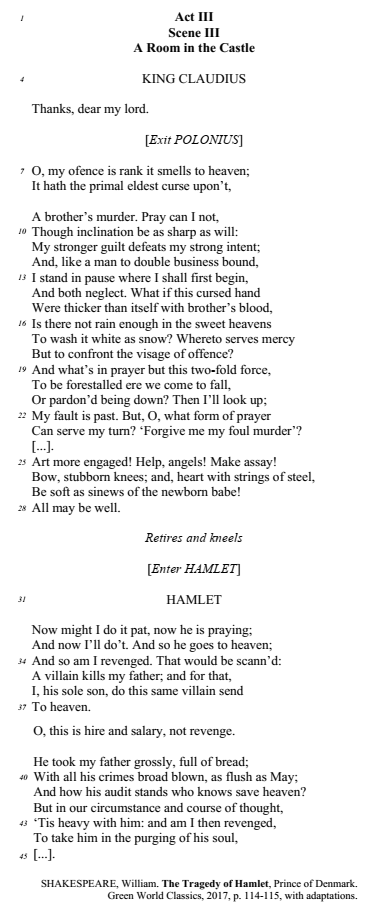
The word “forestalled” in line 20 could be replaced by prevented without changing the meaning of the sentence.
Regarding the vocabulary of the text, decide whether the statements below are right (C) or wrong (E).
The word “forestalled” in line 20 could be replaced by prevented without changing the meaning of the sentence.
Considering the ideas of the text, mark the following items as right (C) or wrong (E).
In line 32, the word “might” can be correctly replaced with the modal verb could.

Considering the ideas of the text, mark the following items as right (C) or wrong (E).
The phrase “And so am I revenged” in line 34 refers to an action that has been fulfilled.

Considering the ideas of the text, mark the following items as right (C) or wrong (E).
Hamlet expresses that his father’s sins were possibly forgiven by God before he was killed.
Considering the ideas of the text, mark the following items as right (C) or wrong (E).
Hamlet’s speech represents the soliloquy.
Analyse the statements below and mark T, if true, or F, if false, according to the text.
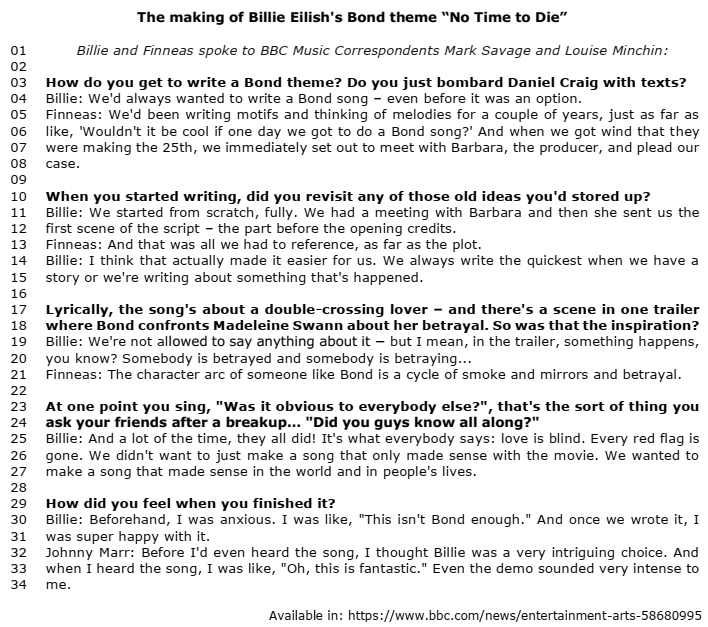
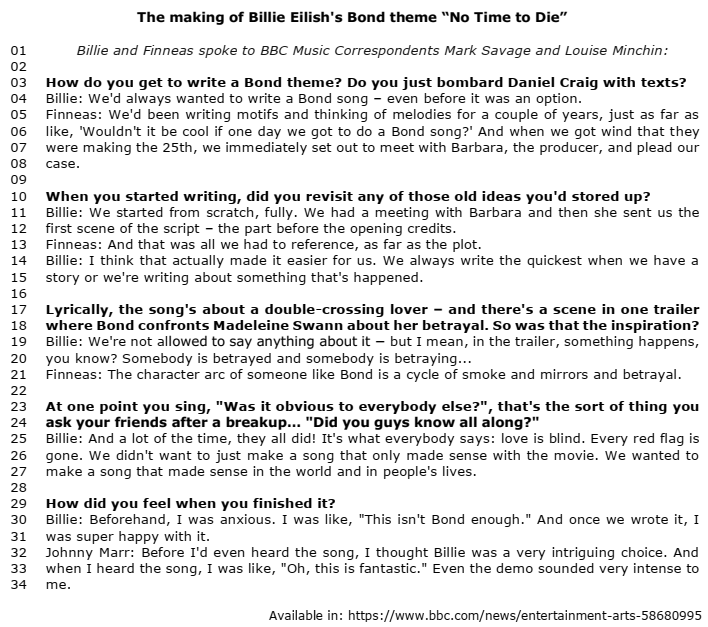
( ) Billie and Finneas had dreamed about writing a Bond theme song long before they had the chance to do it.
( ) The song writers were surprised when the producer invited them to compose the song.
( ) The song is about smoke, mirrors, and betrayal.
( ) Billie and Finneas wanted to write something that people could relate to, not a song that was just about the mov...


Analyse the contractions 1 to 4 indicated by the apostrophes in the excerpts below and the context of the sentences in the article:
• We'd (1) always wanted to write a Bond song. (l. 04).
• We'd (2) been writing motifs and thinking of melodies for a couple of years (l. 05).
• We're (3) writing about something that's (4)...
Analyse the statements below about the excerpt “I think that actually made it easier for us. We always write the quickest when we have a story or we're writing about something that's happened.” (l. 14-15).
I. “Easier” is a comparative form of the adjective “easy”, and it is written this way because the spelling rule for short adjectives ending in consonant + y is to drop the y and add ier.
II. “Quickest” is a comparative form of the adverb “quick”, and it is written this way because the spelling rule for short adverbs in general is to add est.
III. If “easier” were replaced by a long adjective like “beautiful,” its comparative form would be “more beautiful”.
Which statements are correct?

Local accents aside, standard American English has a rule that guides the pronunciation of simple past regular verbs. According to this rule, the “ed” may be pronounced as listed in Column 1. About that, match the correct pronunciation of “ed” in Column 1 to the verbs in Column 2.
Column 1
1. /t/.
2. /d/.
3. /?d/.