1771 Q487516
Língua Inglesa
Ano: 2013
Banca: Centro de Seleção e de Promoção de Eventos UnB (CESPE)

The word “for”, in “for warmth and light bring ecological renewal to what is now an icy desert” (l.16-17), is used to introduce

1772 Q487354
Língua Inglesa
Ano: 2013
Banca: Centro de Seleção e de Promoção de Eventos UnB (CESPE)

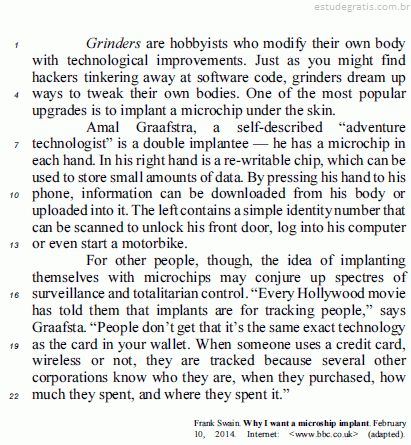
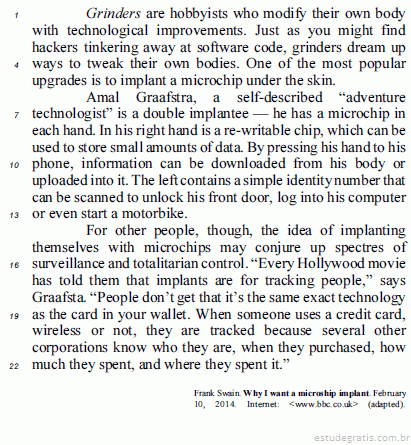
In “who call themselves” (l.1), “who” is

1773 Q487352
Língua Inglesa
Ano: 2013
Banca: Centro de Seleção e de Promoção de Eventos UnB (CESPE)

The word “But” (l.5) is

1774 Q487350
Língua Inglesa
Ano: 2013
Banca: Centro de Seleção e de Promoção de Eventos UnB (CESPE)

The noun “illiteracy” in “the cycle of illiteracy” (l.6-7)

1775 Q487348
Língua Inglesa
Ano: 2013
Banca: Centro de Seleção e de Promoção de Eventos UnB (CESPE)

The verb form “written” in “written in simple, conversational prose” (l.8-9) is in the

1776 Q487346
Língua Inglesa
Ano: 2013
Banca: Centro de Seleção e de Promoção de Eventos UnB (CESPE)

In the sentence “The rainbow troops must constantly defend their extremely poor school against plans to close it” (R.15-16), the modal verb “must” expresses

1777 Q487344
Língua Inglesa
Ano: 2013
Banca: Centro de Seleção e de Promoção de Eventos UnB (CESPE)

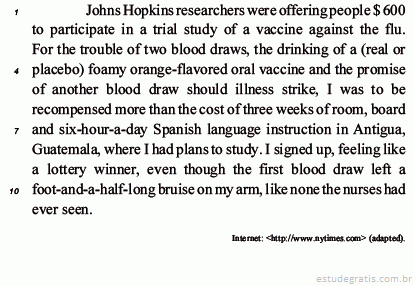
In the clause “When I first met my friend Carol” (l.1), the verbal form is in the

1778 Q487342
Língua Inglesa
Ano: 2013
Banca: Centro de Seleção e de Promoção de Eventos UnB (CESPE)

If the clause “she was the luckiest woman alive” (l.2) had been used in the simple present tense, the verbal form “was” should be replaced by

1779 Q487340
Língua Inglesa
Ano: 2013
Banca: Centro de Seleção e de Promoção de Eventos UnB (CESPE)

In the clause ‘the greatest guy you could meet’ (l.4), the modal verb “could” expresses

1780 Q487338
Língua Inglesa
Ano: 2013
Banca: Centro de Seleção e de Promoção de Eventos UnB (CESPE)

The clauses in “places she’s been or people she’s met” (l.5) are in the