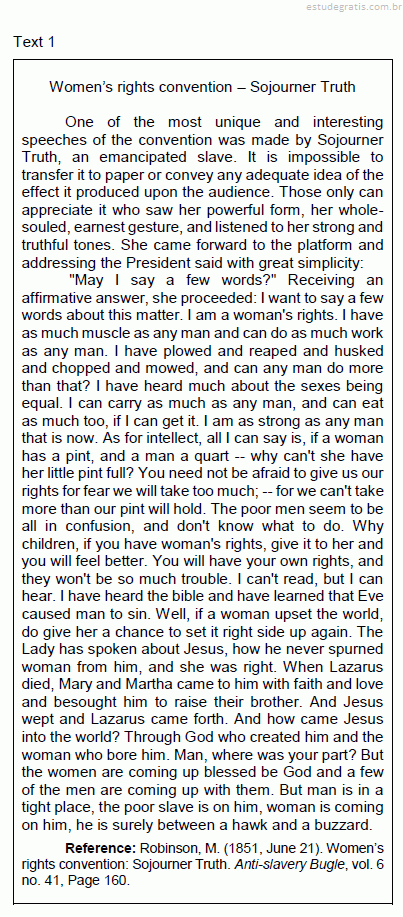
41 Q705950 Língua Inglesa Ano: 0000 Banca: Banca não informada Consider the assertions: I Sojourner’s speech was easily transcribed by the author. II The author agreed with the words Sojourner had put forward. III Sojourner believed men and women should not have equal rights. IV Sojourner used a few analogies to sustain her argument. According to the text, the only correct ones are: A I and II. B II and III. C III and IV. D I, II and III. E II and IV. Responder Comentários Faça login para participar da discussão. Fazer Login Cadastre-se Gratuitamente Carregando comentários...
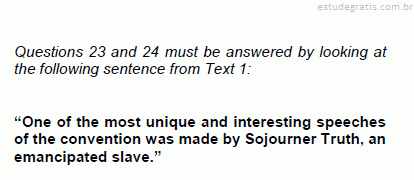
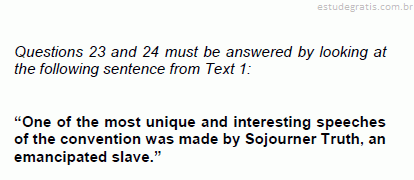
42 Q705949 Língua Inglesa Ano: 0000 Banca: Banca não informada Without any other change added to the sentence, the clause “an emancipated slave” could be preceded by: A which is. B that is. C whose is. D whom is. E who is. Responder Comentários Faça login para participar da discussão. Fazer Login Cadastre-se Gratuitamente Carregando comentários...
43 Q705948 Língua Inglesa Ano: 0000 Banca: Banca não informada The word “whole-souled” in the clause “her whole-souled, earnest gesture” can be defined as: A a negative attributive adjective. B a positive attributive adjective. C a compound noun. D a positive predicative adjective. E a negative predicative adjective. Responder Comentários Faça login para participar da discussão. Fazer Login Cadastre-se Gratuitamente Carregando comentários...
44 Q705947 Língua Inglesa Ano: 0000 Banca: Banca não informada We may keep the sentence grammatically correct by substituting “May” for: A should. B must. C could. D did. E need. Responder Comentários Faça login para participar da discussão. Fazer Login Cadastre-se Gratuitamente Carregando comentários...
45 Q705946 Língua Inglesa Ano: 0000 Banca: Banca não informada We may keep the sentence grammatically correct by substituting “words” for: A information; because it’s an uncountable noun, just like “words”. B informations; because it’s a countable noun in the plural, just like “words”. C things; because it’s a countable noun in the plural, just like “words”. D thing; because it’s a countable noun in the singular, just like “words”. E stuffs; because it’s an uncountable noun in the plural, just like “words”. Responder Comentários Faça login para participar da discussão. Fazer Login Cadastre-se Gratuitamente Carregando comentários...
46 Q705945 Língua Inglesa Ano: 0000 Banca: Banca não informada If you were to report what Sojourner said instead of direct quoting her, you would say that: A she said that she had had as much muscle as any man and she could have done as much work as any man. B she said that she had as much muscle as any man and she could do as much work as any man. C she spoke that she has as much muscle as any man and she could do as much work as any man. D she said that she had as much muscle as any man and she can do as much work as any man. E she told that she had as much muscle as any man and she could do as much work as any man. Responder Comentários Faça login para participar da discussão. Fazer Login Cadastre-se Gratuitamente Carregando comentários...
47 Q705944 Língua Inglesa Ano: 0000 Banca: Banca não informada By saying that, Sojourner Truth meant that: A women can work more than men because they’re stronger. B women must work less than men because they’re weaker. C women can work the same amount as men because they’re just as strong. D women should work the same amount as men because they’re stronger than men. E women can’t work the same amount as men because they’re not as strong. Responder Comentários Faça login para participar da discussão. Fazer Login Cadastre-se Gratuitamente Carregando comentários...
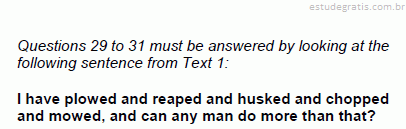
48 Q705943 Língua Inglesa Ano: 0000 Banca: Banca não informada We may say that the verbs Sojourner uses are: A in the Simple Past tense, because all the verbs are preceded by “and” (reaped, husked, chopped, mowed), except the first one (plowed). B in the Perfect Future tense, because she’s talking about her intentions and abilities (she can do all these things that men can). C connected through their grammatical meaning because they’re from completely different lexical contexts. D connected through their lexical meaning and we cannot determine which verb tense they are without reading the whole text. E in the Present Perfect tense, because she starts with “I have plowed” and then omits the auxiliary in the sequence (reaped, husked, chopped, mowed). Responder Comentários Faça login para participar da discussão. Fazer Login Cadastre-se Gratuitamente Carregando comentários...
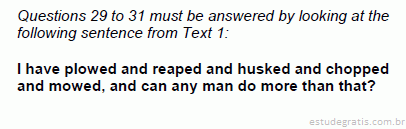
49 Q705942 Língua Inglesa Ano: 0000 Banca: Banca não informada About the use of -ed made by Sojourner, identify the correct and incorrect items: ( ) she uses –ed arbitrarily. ( ) she uses –ed to indicate the completeness of the actions. ( ) these words finish in –ed because they mark the perfective aspect of the verbs. ( ) these words finish in –ed because they’re adjectives. The alternative that best represents the appropriate sequence, top-down, is: A incorrect; incorrect; correct; correct. B incorrect; correct; correct; incorrect. C correct; incorrect; correct; incorrect. D correct; correct; incorrect; incorrect. E correct; incorrect; incorrect; correct. Responder Comentários Faça login para participar da discussão. Fazer Login Cadastre-se Gratuitamente Carregando comentários...
50 Q705941 Língua Inglesa Ano: 0000 Banca: Banca não informada When Sojourner chooses to use “can” in “and can any man do more than that?”, she does it because: A she wants to question men’s ability to do more than she does. B she’s asking for permission to continue doing what she does. C it’s an informal situation and “could” would be too formal. D she’s talking about what she did in the past. E she knows men will never do what she does. Responder Comentários Faça login para participar da discussão. Fazer Login Cadastre-se Gratuitamente Carregando comentários...